

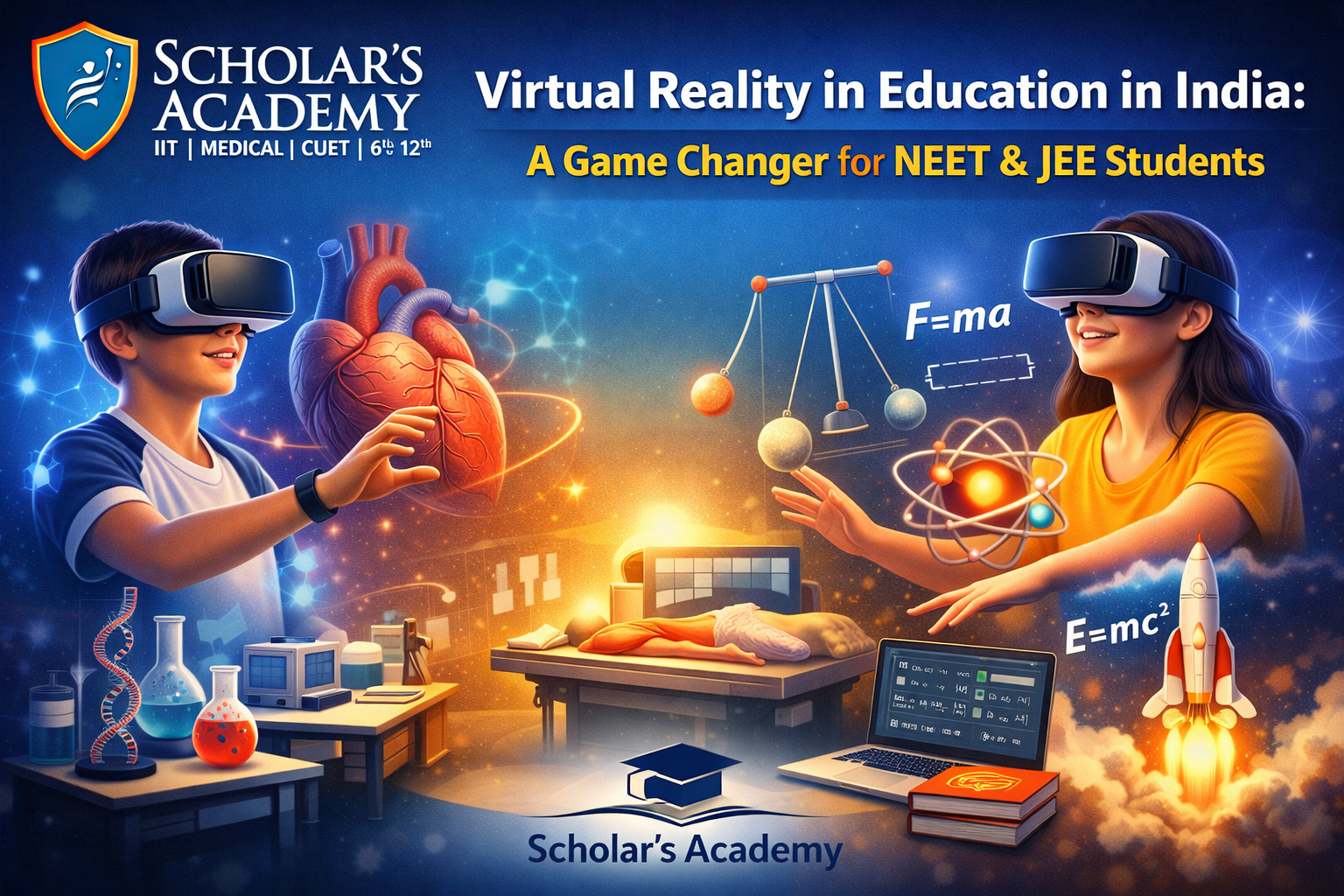
Virtual Reality in Education in India is a medium through which learners are able to immerse themselves in a 3D virtual educational environment.
The greatest advantage of this technology is that complex topics—such as human anatomy or physics—can be not only comprehended but also experienced.
These days, merely sleeping well is not enough for those preparing for very competitive exams like NEET and JEE. Indeed understanding of concepts is the key to success. This is why virtual reality stands out as a revolutionary change.
Still, what if instead of learning the anatomy of the heart by heart, you physically enter through the chambers of the heart, or you see that the law of gravity is always vertical—how much easier would learning be? Scholar’s Academy is one of the few institutions focusing on a smart study approach that actually gives students an edge.
What is Virtual Reality in Education?
Example:
- Exploring 3D organs in Biology
- Understanding physical motion in Physics
- Learning about molecules in Chemistry
- Being so engrossed, you forget that you are in a lesson.
This makes learning interesting—not boring
How VR is Used in Indian Education System
Virtual Reality for Students in India is not limited to only a handful of schools but it is spreading very fast through schools, coaching classes, and online education websites too.
Here’s how VR is being used:
- Virtual Labs
A student can practically perform a chemical reaction, or dissection in biology and physics experiments without a lab. - 3D Concept Visualization
3D Concept Visualization With VR students can physically look at molecules or atomic structures. - Interactive Learning Modules
The students physically participate in the VR classes as compared to the teacher’s traditional monologues which are tedious. - Remote Learning Enhancement
Remote Learning Enhancement Via a VR class, a student can engage with a teacher inside a virtual school.
This phenomenon benefits not only NEET/JEE candidates but students who want conceptual clarity and strong foundations in general.
How VR Helps NEET & JEE Students
Preparing for NEET and JEE exams is not just about memorizing facts; it demands a thorough understanding of concepts. In this context, VR can be an excellent educational resource.
1. Better Concept Clarity
Biology becomes less daunting for NEET students if they can see the organs, systems, and their functions in 3D. This is just one example.
Using VR for NEET preparation, students can:
- Discover what the human body looks like at a microscopic level
- Work through complex biological mechanisms step-by-step
- Increase their ability to remember educational material
2. Improved Physics Understanding
Physics is one of the subjects that are really challenging for JEE students. With the assistance of VR for JEE Physics, the students can both view and interact with abstract notions.
Students can:
- See how forces work in real-time
- Understand motion, waves, and electricity visually
- Practice problem-solving in simulated environments
3. Increased Engagement
Using conventional learning techniques may be tiresome for learners. VR, on the other hand, rejuvenates studying as a whole and thereby, the motivation and focus level also increases.
4. Safe Experimentation
Students can conduct risk-free virtual experiments raising the pedagogical value of the subject.
5. Time Efficiency
VR helps students to grasp concepts in a shorter period, hence gaining more free time for other activities.
Scholar’s Academy considers the use of these up-to-date methods as a way to dramatically elevate the level of achievement in their competitive exam students.
Advantages of VR in Education
VR offers many educational benefits that make it a real revolution:
1. Immersive Learning Experience
When students get a feeling of participating in the lesson, their ability to absorb and retain it gets enhanced.
2. Better Memory Retention
Combining the visual and interactive aspects of a lesson allows students to commit study material to memory for longer.
3. Personalized Learning
With this technology, students can learn independently and easily review parts they did not understand.
4. Accessibility
The best learning resources would be available to everyone irrespective of their location or affluence.
5. Boosts Confidence
Engagement with a virtual environment prior to an actual exam leads to a higher level of self-confidence.
6. Reduces Fear of Difficult Subjects
Physics, chemistry and alike cease to be scary once the explanation is given visually.
In brief, VR in education India is revolutionizing education and student-centric learning.
Future of VR in India
Very bright are the prospects for Virtual Reality in Education in India.
The rapid increase of digital learning along with the supporting policies of the government are factors that will make VR more present and more affordable in the future.
In the coming years, we can expect:
- VR-based learning environments in educational institutions
- Achieving through simulations for the preparation of competitive exams
- Custom-tailored learning experiences via the convergence of AI and VR
- Use of VR becoming widespread in schools for NEET and JEE coaching
Scholar’s Academy is already moving towards innovative teaching methods to stay ahead and provide the best learning experience.
However, it is very likely that in the future using VR will not only be a choice but also a requirement.
Conclusion
Virtual Reality in Education in India is indeed reshaping the way students learn and prepare for competitive exams like NEET and JEE.
VR contributes towards making the learning process interactive, visual, and engaging thereby helping a student to understand a complex concept quickly and efficiently.
Adopting new tools like VR can provide students preparing for top ranks a significant advantage. And as a result, education will become an opportunity for every learner to deliver his or her best. Thus, it will be right to say that the future of education and Scholar’s Academy is that of continuous innovation and progress.
IF you want to check your JEE Percentile then check our brand new tool – JEE Percentile Predictor
Is VR helpful for NEET preparation?
Yes, VR for NEET preparation helps students visualize biology concepts, making learning easier and more effective.
How does VR help in JEE physics?
VR for JEE physics allows students to see and interact with physical concepts, improving understanding and problem-solving skills.
Is VR widely used in India?
The use of Virtual Reality For Students in India is growing rapidly, especially in coaching institutes and online education platforms.
What are the main advantages of VR in education?
The key advantages of VR in education include better understanding, higher engagement, improved retention, and personalized learning.