

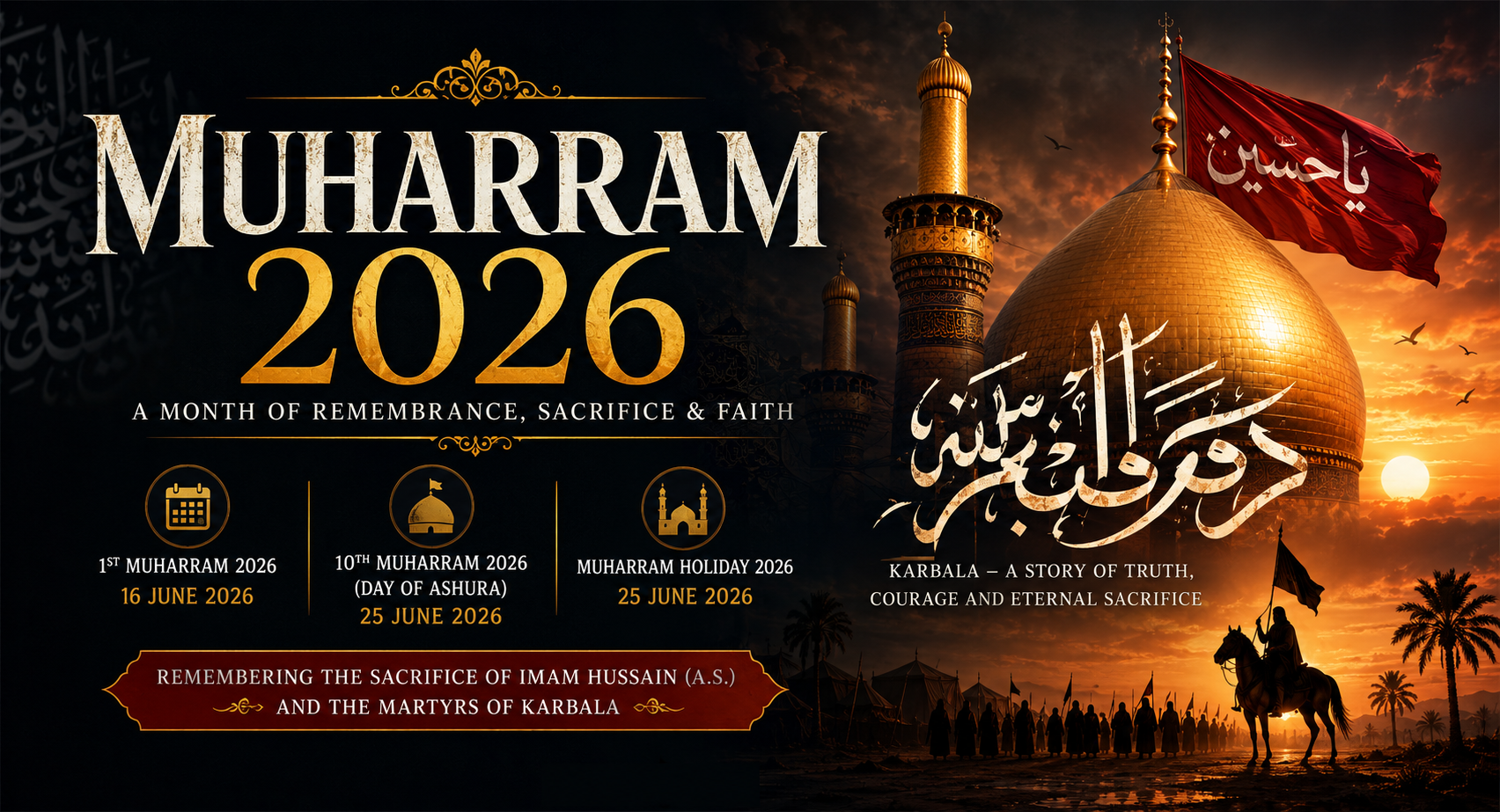
Muharram 2026: History, Ashura Significance & Karbala Martyrs
Scholar’s Academy offers a detailed guide on Muharram 2026, a very holy and highly emotional period for the Islamic communities worldwide. It is the time of the year when the New Year of the Islamic calendar begins and is spiritually of utmost importance to the Muslims. It is the month in which the martyrdom of Imam Hussain (A.S.), the revered grandson of the Prophet Muhammad (PBUH), and his family members and companions who made the ultimate sacrifice in their loyal resistance against injustice and tyranny are commemorated.
In terms of the Islamic calendar Muharram 2026 date is considered to start June 16, 2026, while the 10th of Muharram or the Ashura Day is going to be on June 25, 2026. Muslims all around the world flock to the mosques on such holy days for prayers, mourning processions, majalis, fasting, and remembrance ceremonies. While other parts of India are busy choosing their vibrant Navratri 2026 Colours for the autumn season, the Muslim community is deeply engaged in spiritual mourning and historical consciousness of the event of Karbala. These coinciding events show the diverse and interwoven spiritual traditions of South Asia.
We, Scholar’s Academy, are here with a detailed and SEO-friendly article on the significance of Muharram holiday 2026, the Karbala historical background, and the sacrifices during Muharram 1st to 10th that the readers may find useful and informative.
Day-by-Day Events of Muharram 2026
1st Muharram 2026 – 16 June 2026
The first day of Muharram 2026 marks not only the start of the Islamic New Year but also the beginning of the most historic and impactful ten days in Islamic history. The new Hijri calendar year arrives amidst a deep moral dilemma: Yazid ibn Muawiyah, the corrupt and tyrannical ruler of the Umayyad caliphate, had asked Imam Hussain (A.S.) — the grandson of the Prophet Muhammad (PBUH) and the symbol of Islamic principles and justice — to pledge a formal oath of loyalty. Imam Hussain (A.S.) emphatically declined, stating that a person of his noble descent and high moral character could never bow to a man whose ways and character were as low as Yazid’s.
The refusal was about far more than politics — it was the moral affirmation that truth must be upheld at all costs. The Imam had left Mecca and was heading towards Karbala with his family, his children, and his loyal companions. One of the characters, whose emergence was evident even before the 1st of Muharram, was Hazrat Muslim ibn Aqeel (A.S.) – the faithful cousin of Imam Hussain (A.S.).
Muslim ibn Aqeel (A.S.) had been dispatched to Kufa by the Imam on the request to verify the genuineness of the large number of Kufans who had sent letters to Imam Hussain pledging their support and inviting him to lead them. This was one of the most dangerous missions of Muslim’s life – to go deep into enemy territory, through the difficult task of measuring the extent of public loyalty, and finally, to deliver the report to the Imam.
At first, the reply in Kufa was extraordinary. Together with Muslim ibn Aqeel, tens of thousands swore their allegiance and willingness to fight for Imam Hussain. Nevertheless, the governor, Ubaidullah ibn Ziyad, immediately proceeded to suppress this support wave through intimidation, bribery, and terror. Within a few days, the masses were scattered and Muslim ibn Aqeil was almost left alone. Finally, he was taken, tortured, and executed, but not prior to that he sent a last note to Imam Hussain alerting him of the hostile atmosphere of Kufa.
Imam Hussain, who was informed about the martyrdom of Muslim, was very sad; however, he still proceeded on his journey and stated that those who give their lives to the cause of truth cannot retreat.
Hence the lesson of the vulnerability of the public fortitude and the unshakable determination of the few truly committed to justice. Muslim ibn Aqeel’s martyrdom provided the ethical basis for subsequent events.
2nd Muharram 17 June 2026 – Arrival in Karbala
On the 2nd of Muharram, Imam Hussain’s (A.S.) The caravan reached the land which would later become the most spiritually significant site for Shi’a Muslims — Karbala. When the Prophet asked the name of the place and was told it was “Karbala,” he remained silent for a moment and, according to historians, he said: “This is the land of sorrow and affliction.” There was no doubt in his mind that this bare stretch of land beside the river Euphrates in present-day Iraq would witness his and his loyal ones’ ultimate sacrifice.
The outskirts of a deserted area were taken by the caravan for camping. Among them was Hazrat Abbas ibn Ali (A.S.) alias Abbas, the younger brother of Imam Hussain and an extremely famous Muslim personality. Being the son of Imam Ali (A.S.) and Fatima bint Hizam (also known as Umm ul-Banin), one of the greatest qualities of Abbas was his willingness to sacrifice even his life for the blood lineage of the Holy Prophet. Abbas had been granted the title of standard-bearer and commander of the camp — a function which he was to perform with great dignity and that ultimately led to his glorification through the ages.
Abbas ibn Ali (A.S.) had a striking personality besides being a great fighter. He was the emotional appeal of the camp. He delegated the erection of the tents, mobilised the companions, and took charge of protecting the women and children. His attendance was giving a sense of tranquility and security to the camp. The association between him and the Imam was so strong that when referring to the latter, Abbas commented not only brother but also on the master and Mawla. He was totally committed to the Imam without leaving any room for doubt.
The day of reaching Karbala also marked the day when by degrees the Seclusion begun that was only to be intensified further in the following days. Besides being far from cities, surrounded by desert, the camp was under the open sky of Iraq and no one was expecting substantial reinforcement. Therefore, it became a stronghold of faith against the oncoming attack of thousands.
3rd Muharram 18 June 2026 – Growing Tensions Around Karbala
Enemy Forces Multiply
Key Figure: Zuhair ibn Qain (A.S.)
On the 3rd of Muharram, more troops of Ubaidullah ibn Ziyad, the governor of Kufa, sent by Yazid, started arriving at Karbala in increasing numbers. Umar ibn Sa’d, a noble man by birth, but a soul utterly lacking in integrity and conscience, was designated as the head of the hostile troops. At first, he tried to avoid the task, since he realized the immense spiritual consequences of fighting against the Prophet’s grandson, but the lure of becoming the governor of the Ray region made him agree. His agreement was a major betrayal of conscience, a sin history will never pardon.
While the enemies were increasing their strength, the members of Imam Hussain’s army did not respond with fear but with even stronger expressions of their loyalty. One of the most notable changes in character was that of Zuhair ibn Qain (A.S.). Although Zuhair was actively siding with the enemies of the Prophet’s family and even avoiding Imam Hussain in the beginning, he was totally converted by their short meeting. After meeting the Imam, he could not resist winning over his friends, giving away his belongings, saying goodbye to his wife, and completely joining the Imam’s forces.
On the 3rd of Muharram, Zuhair boldly confessed in front of the camp his dedication to Imam Hussain’s cause, deserted any allegiance to Yazid’s government, in fact, he gave an electrifying effect to other companions. His testimony was the illustration of the significant aspect of Karbala that reminds us that it is never yet too late for the morally awakened to decide for the right side despite their past. Zuhair’s transformation from a state of reluctance to becoming a brave hero continues to be the most well-known and impactful personal story of the Muharram commemoration.
4th Muharram 19 June 2026 – The Circle of Hardship Tightens
The Camp is Encircled
Key Figure: Lady Zainab bint Ali (S.A.)
The enemy troops decided to make a new move on the 4th of Muharram. Imam Hussain’s (A.S.) surroundings was changed into an armed encirclement, which restricted movement. The camp’s mood was influenced by the change, and the formerly safe desert began to feel like a cage. However, the place’s residents’ souls remained their own. Imam Hussain was still leading prayers, giving spiritual talks, and personally dealing with the morale of every person under his care.
One of the outstanding members of the community during this period was Lady Zainab bint Ali (S.A.), the sister of Imam Hussain and the daughter of Imam Ali (A.S.) and Hazrat Fatima al-Zahra (S.A.). Zainab’s role in the events of Karbala was indeed grand and she was the mainstay of the camp’s spiritual strength. When the enemy encirclement was tightened, and the fear among women and children intensified, Zainab moving through the tents calmly, offering solace, praying and strengthening the faith of the terrified ones.
Historians point out that it was Zainab who kept the emotional fabric of the camp intact in the lead up to Ashura. Her understanding — just like that of her brother — was that the tragedy was inevitable. She had been raised in a family where sacrifice and prophecy were daily talk; her father, mother, and Imam Hasan, her brother, were all victims of the harshness of political tyranny. Her readiness for such a moment was simply the wisdom gained through years of walking spiritually side-by-side with truth. The source of her strength during that time was not a denial of sorrow but rather an unwavering faith that changes sorrow into a determined endurance.
This is why the date 4th of Muharram reminds us of the inner struggles of Karbala — the heart struggles — which were equally ferocious as the physical fights that were to take place on Ashura.
There are similarities drawn by a lot of scholars between the emotional side of the Muharram congregations and the spiritual ceremonies in India. For instance, people look for Navratri 2026 Colours as a way of showing their love and faith in various traditions.
5th Muharram 20 June 2026 – Loyalty of the Companions
The Unbreakable Loyalty of the Companions
Key Figure: Hazrat Habib ibn Muzahir (A.S.)
On the 5th of Muharram, there was no denying the harsh facts of their predicament to anyone in the camp. The enemy had tirelessly increased their number to thousands. Water was running out. The escape routes were under strict surveillance. However, in an act that is the very hallmark of the spiritual essence of Karbala, not even one companion of Imam Hussain (A.S.) decided to quit. They all realized what it meant to stay — and they all decided to go through with it.
The tidal wave of continued commitment to such loyalty was embodied in the person of Hazrat Habib ibn Muzahir al-Asadi (A.S.). Habib was an aged person — he was a companion who not only met the Prophet Muhammad (PBUH) but had devoted his entire existence to supporting the household of the Prophet. At the time of Karbala, he was fairly old but his zeal for Imam Hussain was that of a young man. On the night before the fight when Imam Hussain allowed his companions to leave, Habib has been reported to have said that his sword was still strong enough to defend the grandchild of the Prophet and that he would rather perish than forsake his Imam.
Besides this, Habib ibn Muzahir was the one who attempted to get help for the camp. He contacted the Banu Asad tribe who were nearby and with whom he had family and tribal ties, asking them to come to the aid of Imam Hussain. Seventy horsemen from the tribe took off towards Karbala that night but they were surrounded and forced to return by Umar ibn Sa’d’s troops. Even though they did not succeed in the end, this shows that the companions were not just the passive victims but they were the active protectors of the truth.
The nights of 5th and 6th Muharram went by in worship and spiritual reflection. The camp’s nights echoed the holy Quran, individual prayers and supplications, and the subdued discussions of those who were preparing their souls for the supreme trial. Such an ambience of nighttime worship — being aware that death is near and yet finding serenity in worship — is one of the reasons that the global observance of Muharram holiday 2026 is marked with such deep and solemn reverence.
6th Muharram 21 June 2026 – Increasing Hardships
The Water Crisis Deepens
Key Figure: Hazrat Abbas ibn Ali (A.S.) — The Saqqa
On the 6th of Muharram, the distress of the camp escalated drastically as the access to the Euphrates River — the only water source available in that region of the Iraqi desert — was almost completely denied by Yazid’s forces. What was a problematic situation suddenly became a humanitarian disaster. The water source of the camp was running out, and the most vulnerable to the lack of water were the children: family members and followers of Imam Hussain.
It is during this time that Hazrat Abbas ibn Ali (A.S.) truly deserves the recognition of Saqqa — the water-carrier, the one who brings water to the thirsty. Without fear, Abbas would lead the trips at night to the river, trying to get water for the children and women of the camp. Once, he managed to reach the river and fill up a large water skin, starting the way back to the camp. However, he did not drink a single drop — even though he was very thirsty — thinking that he could not drink if Imam Hussain and the children were left without. This story of self-sacrifice has become one of the most charming and most often told stories of Karbala in the entire world.
Imam Hussain (A.S.) also gave an excellent sermon on the 6th of Muharram, where he spoke about the evil regime of the tyrant Yazid, whose intention was to kill the pure self of the Prophet’s household and devalue the religion of Islam. He also warned Umar ibn Sa’d against the eternal consequences of their actions and finally implored him to reconsider. However, it was evident that the companions of the Imam were all ready to accept death and so there was no longer any need for bloodshed.
7th Muharram 22 June 2026 – Water Supply Blocked
The Euphrates Blockaded — Total Thirst
Key Figure: Hazrat Ali Asghar (A.S.)
The 7th of Muharram saw Umar ibn Sa’d announcing an official and complete shut down of the Euphrates River. A group of soldiers was assigned their duty of stopping anyone getting out of Imam Hussain’s camp from approaching the water. It was a deliberate act of barbarity — not a war necessity but a wicked means to have Imam and his associates give up their resistance through the suffering of the innocent children and women. The Islamic moral code and international humanitarian laws both condemn such tactics as violations of human rights.
During the encampment, thirst took over as a very harsh physical and emotional reality. The temperature on the Karbala plains in early summer sometimes even reached extremes and without proper water everyone suffered greatly, especially the very young. Hazrat Ali Asghar (A.S.), the six-month baby of Imam Hussain (A.S.) and his wife Rubab, was the most dreadful representation of this hardship. This little one, who was hardly breastfed, kept crying from thirst. His destitute suffering was not only an incident to Karbala but was at the heart of the tale reflecting the conscience of each generation who has heard it since.
More than a few times Imam Hussain (A.S.) with his baby in his arms walked to the enemy lines and even talked directly to the soldiers, most of them fathers and brothers, appealing for just a drop of water for the child. All these requests were denied. The sight of Imam Hussain holding his parched infant in front of an army and getting no mercy is one of the most piercing moral images in all the religious stories. It would be etched in the memory and on the Day of Ashura it would be manifested in the most painful way.
8th Muharram 23 June 2026 – Final Preparations
Key Figure: Hazrat Qasim ibn Hasan (A.S.)
In the camp of Imam Hussain (A.S.), the 8th of Muharram was characterized by a heightened spiritual level. The enemies’ troops were visibly deployed, no compromise was possible as all proposals were rejected, and the water blockade had already crushed the very hope of any peaceful settlement; therefore, Imam Hussain held a highly emotional meeting with his supporters and relatives. Upon putting out the lamp, he informed them openly: that where one day or two days hence, the inevitable event will unfold. If any of you wish to avail the overtaken night to escape out safely I allow you to do so.
The reaction was one of the most touching joint statements in human history.
Each of the companions listed their reasons for standing with Imam Hussain (A.S.):
In the presence of the Prophet’s sons looking on, the sons of Imam Ali declared to stay there. The sons of Aqeel stated that since Muslim ibn Aqeel had already died for the cause, they should not dishonor his sacrifice. With figurative eloquence and pure dedication to the cause, the companions such as Habib ibn Muzahir, Zuhair ibn Qain, and others pledged their lives, and even Imam Hussain was moved to tears — not because of sorrow, but because of the boundless gratitude a leader feels on seeing the best human beings of his time standing by him.
The one who emotionally stated his candidness in standing with Imam Hussain, along with others, was the teenage Hazrat Qasim ibn Hasan (A.S.). Qasim was the son of Imam Hasan (A.S.) and the nephew of Imam Hussain. With the toddler’s faults and the utterly clear faith, Qasim asked his uncle: “If I am to be one of the martyrs, then I would like to be so.” This question deeply affected Imam Hussain and he replied in the affirmative.
From sunset on the 8th until sunrise on the 9th worship, prayer and telling the Holy Quran kept interrupting their sleep. Some of those in the camp who got sleep did not, and the others who could not get sleep prayed. The desert around them was surrounded by the enemy army’s torches; in the sky, they could see many stars. Karbala, then the city holding its breath, was the last day of the battle against the infidels.
9th Muharram Tasu’a · 24 June 2026 – The Night of Ashura
The Sacred Night Before Ashura
Key Figure: Hurr ibn Yazid al-Riyahi
The 9th of Muharram, which is Tasu’a, the ninth day, is one of the most emotionally intense days of the whole Muharram period. That was the day before the Battle of Karbala and the last sunset that the companions and family of Imam Hussain (A.S.) stood together before the Ashura changed the world. Besides everyone in the camp, the enemy army too who were at their camps felt the day possessed a certain heaviness.
The defection of Hurr ibn Yazid al-Riyahi from the army of Umar ibn Sa’d and his repentance was one of the most remarkable incidents of that day which was highly charged with emotions. Besides, Hurr was a man of great removing a starting point of honor to the military establishment that was Kufan as he was a commander in Umard ibnSa’d’s army. Hurr was the first responsible person who stopped the Imam’s caravan on its way and then sent it to Karbala as per the orders of Ubaidullah ibn Ziyad. Hurr was able to keep a degree of admiration for Imam Hussain since he even forbade his troops to show any disrespect to the Imam but was still with the enemy and seemed to be stuck in the dilemma of whether he crossed the line of his duty or not.
However, on the day of Tasu’a, that moment came. He was ridden by conscience, saddened seeing the innocent children, the thirst and the thirst and more clearly delineated moral reality about who was on the right side. So Hurr slowed his horse and left the enemy formation while his body shivered like the physical aspect of his inner struggle. Then he crossed the distance between the two camps, dismounted his horse, and went to Imam Hussain, crying and asking God to forgive him. His statement: “By God, I stand between heaven and hell, and I choose heaven” is one of the best moral courage and repent in most gatherings the world over.
On that same instant when Imam Hussain revealed his unexpected gesture of granting permission to all those who intend to leave to do so one final time, the stage was set for the final round. In a repeated prayer for – that I have no condemnation of anyone leaving this place. Take the cover of darkness. Take your families and go. They only want me – if they have me, they will leave you all in peace. And yet, despite all this, not a single person left. Demonstrating faith and allegiance to their imam, the companions responded unanimously with heartfelt declarations.
During the whole night of Tasu’a, they were worshipping in a very spiritual way. The prayers, cries, verses of the Quran were flowing from the tent of Imam Hussain all night long, mixing with the atmosphere of Karbala.
Imam Hussain’s companions and their relatives were washing, getting ready physically and mentally. It was a night of hallowed farewell to life here and nearing life in the hereafter. The stars of the 10th of Muharram started to appear, each person of that little camp was aware that the sun that would be rising over Karbala would also be the last day of their living on earth. They welcomed it with “La ilaha illallah” — there is no god but God — dripped from their lips.
10th Muharram 2026 – Day of Ashura (25 June 2026)
The Battle of Karbala and Martyrdoms
Ashura, the tenth day of the month of Muharram, is the central point around which the whole history of Islam revolves. Muslims all over the world will observe this singular day on 25 June 2026. At dawn in Karbala, Imam Hussain (A.S.) along with his seventy-two followers performed the fajr prayer. It was one after another, the most noble ones of that era walked on the scorching grounds — and went to the eternal abode.
That day which is the 2026 Muharram holiday observed globally on Ashura reminds us of when a handful of noble and virtuous souls faced a well-armed hostile force numbering in the thousands. Imam Hussain (A.S.) was given a last chance to surrender and live. He declined — opted for honourable death rather than life under tyranny. After the Tasu’a morning, the fighting broke out, with the foe making its first strike at sunrise.
“Every day is Ashura, every land is Karbala.” — A maxim of Shia remembrance
The Final Stand: Martyrdoms on the Day of Ashura
Imam Hussain’s supporters continued to battle, one by one dying – ensuring that the Imam was protected, each one departing to their Lord with faith written on their tongues.
Below is a table listing the main heroes of Ashura, along with their family background and the way in which they died.
Major Martyrs of Karbala
| Name | Relation to Imam Hussain (A.S.) | Sacrifice |
| Hazrat Abbas (A.S.) | Half-Brother | Martyred while bringing water for children |
| Hazrat Ali Akbar (A.S.) | Son | Fought bravely despite young age |
| Hazrat Qasim (A.S.) | Nephew | Young martyr who defended truth |
| Hazrat Ali Asghar (A.S.) | Infant Son | Martyred while suffering from thirst |
| Habib ibn Mazahir (A.S.) | Loyal Companion | Elderly warrior who stood firmly |
| Zuhair ibn Qain (A.S.) | Companion | Defended Imam Hussain courageously |
| Imam Hussain (A.S.) | Grandson of Prophet Muhammad (PBUH) | Supreme sacrifice for Islam |
Imam Hussain’s (A.S.) martyrdom has become the everlasting image of resistance to wrongdoing. His selflessness has been motivating various human beings as a source of guidance worldwide until today.
Historical and Spiritual Significance of Karbala
It would be wrong to view the Battle of Karbala, which was fought on the 10th day of the month of Muharram 61 AH (October 10, 680 CE), as just a mere clash between two armies. It was not only a confrontation between two individuals or even between two armies but it was a conflict between the very essence of two civilizations, a clash between the two vices with one being against the other, one being the instinctive or typical human will whereas the other being the superhuman or saintly will – one being an eternal principle whereas the other being the material or temporal throne. Imam Hussain (A.S.) realised that not speaking out against the wickedness of Yazid was going to affirm the legitimation of a gross distortion of the message of Islam already at its very foundation.
The events of the Day of Ashura are very much alive and happening for the Shia, as was the case for those living at the time some 1400 years ago. Labayk Ya Hussain or “Here I am, O Hussain” is the chant that one can hear in the processions of those who are mourning Karbala in cities of Iran, Iraq, Pakistan, India, Lebanon, and other parts of the world which is a sign that the message and the spirit of Karbala is still going strong. And the fast of Ashura which is part of the very meaningful religious activities of Sunni Muslims too has its roots in the observance of fasting of Prophet Muhammad (PBUH) on this very day.
The women and children who survived the Karbala massacre were led by Hazrat Zainab bint Ali (A.S.), the sister of the Imam, and were taken as prisoners to Damascus. Zainab was brave and she spoke in front of Yazid’s court. Instead of killing the message of Hussain (A.S.), these speeches of Zainab became the way through which the truth of Karbala was kept and spread all over the Islamic world. Zainab (A.S.) played such a big role that some people believe that without her, the name of Hussain might have been forgotten.
Muharram 2026 Observances and Traditions
The Muharram holiday 2026 is a time of deep reflection and mourning throughout Muslim communities worldwide. The main ways of observing it may differ from one tradition to another, yet all share the common element of remembering (zikr) and expressing grief (azadari).
The Shia community mourns the first ten days by attending majalis — which are the mourning gatherings where scholars tell the story of the events of Karbala. Besides that, processions (julus) take place, and people wear black to show that they are mourning. Homes and community centers resonate with the singing of nohas (lamentations) and the reading of latmiyya poetry. Some people also do a fast on the 9th and 10th of Muharram. Following the example of the Prophet, Sunni Muslims usually fast two days i.e., the 9th and 10th of Muharram.
- Fasting on the 9th and 10th of Muharram (Tasu’a and Ashura) is regarded as a strong Sunnah practice.
- Mourning meetings (majalis) take place every night starting from the 1st to the 10th where recitations and stories of Karbala’s events are the main attractions.
- In cities all over South Asia, the Middle East and other places, there are processions and public marches to pay respect to the martyrs.
Along with that, giving charity, feeding the poor, and doing community service are also important parts of Muharram — they are the ways of showing respect to Hussain (A.S.) who sacrificed his life for the benefit of the whole of humanity.
Conclusion
Muharram is a time for remembering — not for despairing. The central message of Karbala is a reflection on what it means to be human when we are subjected to great pressure to give up our values and conform. Imam Hussain (A.S.) took the difficult route — and because of that, he showed the way to all the generations that came after him.
Scholar’s Academy has always maintained that teaching history thoroughly and with compassion can transform it into a great teacher. From 16 June 2026, which is the first day of Muharram, until 25 June 2026, the Day of Ashura, the time is filled with significant historical and emotional moments. The selflessness of Imam Hussain (A.S.), Hazrat Abbas (A.S.), Hazrat Ali Akbar (A.S.), Hazrat Qasim (A.S.), and the many other companions continue to serve as a source of motivation for people to stand up for justice and truth irrespective of the situations.
If you have just landed on this page and are here to check the Muharram 2026 date, or understand more about the companions of the Imam, or share this knowledge with others, we wish that this piece has helped you understand the deep humanity that is at the core of the story of Karbala.
While communities worldwide are witnessing the Muharram 2026 holiday through various programs and rituals, some are also planning the celebration of cultural festivals and thinking about thanksgiving for Navratri 2026 Colors and other joyful festivities. In this way, acts of remembrance, prayer, and the celebration of human achievements that bring people and religions closer to each other should be not just wishful thinking but practical steps towards making our world a better place.
“The death of Hussain awakened Islam.” — Thomas Carlyle
Scholar’s Academy is a platform of truthful, academically rigorous and historically accurate materials that not only inform but also make readers aware of the significance of religious and cultural events. Let the remembrance of Muharram 2026 bring serenity, revival and insight to the souls of all seekers.