

The same concern is on every NEET test taker’s face after the results come out. Those who attempted 180+ questions start to doubt themselves. Those who attempted 145+ start to worry about the attempts they left. The reality is, neither of the figures mean anything to you. The only thing that determines this is how many of those attempts you got correct.
NEET 2026 has made this even more clear. With the happening of the Re-NEET, on the 21st of June, because of the cancellation of the May 3rd paper, this year has already been unusual. Most students rated the exam as having a moderate to high level of difficulty, and the cut-offs should reflect this according to the experts. If you have just come out of the exam, or are trying to understand where you stand, this is for you.
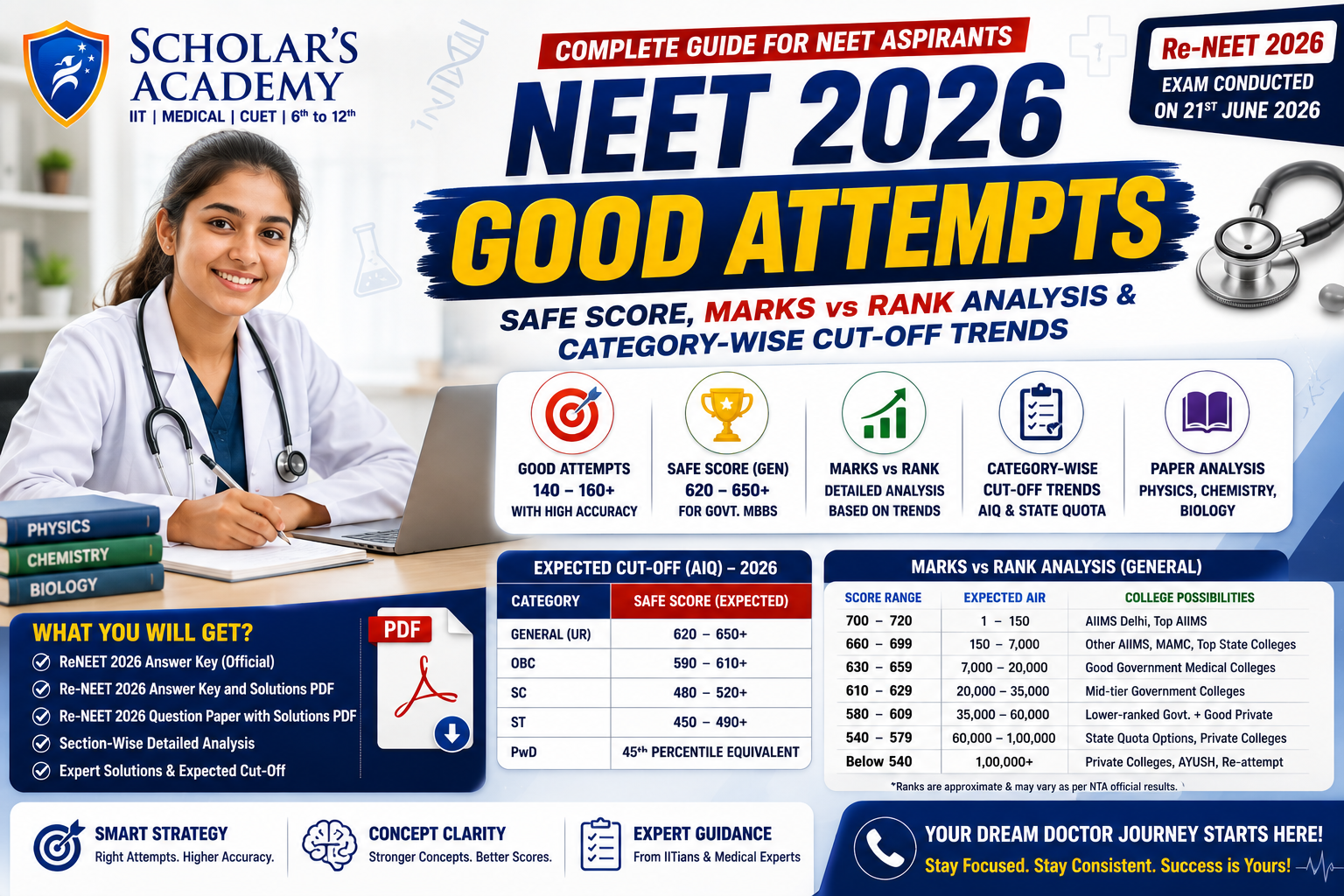
Quick Answer: NEET 2026 Good Attempts & Safe Score
For the NEET 2026 exam attempts at this level would not only consider the number of questions attempted. The most important factor would be the accuracy of the attempts, due to negative marking.
Students wishing to rank in a good government medical college should consider:
- An attempt range of 140–160+ with high accuracy is considered a good attempt. range.
- Marks in the range of 620–650+ would be a competitive score for students of the General category, wishing to secure the government MBBS seat.
- Biology is the highest scoring section while question selection is important for scoring in Physics.
- A safe score would depend on category, state quota, level of competition, and overall level of difficulty of the paper.
NEET is a comparative examination. This means that your final rank not only depends on your score but on the performance of the other candidates.
What Are “Good Attempts” in NEET 2026?
Good attempts is a term that is used by both students and faculty, but it is not an official term. This is primarily because NEET has a peculiar pattern of marking, and good attempt counts do not show up in a raw attempt count.
NEET awards +4 for every correct answer and deducts 1 for every wrong one. That sounds simple until you do the math at scale. A student who attempts 180 questions with 75% accuracy scores 180 × 0.75 × 4 minus 180 × 0.25 × 1 = 540 minus 45 = 495. A student who attempts 150 questions with 90% accuracy scores 150 × 0.9 × 4 minus 150 × 0.1 × 1 = 540 minus 15 = 525. Same raw attempt pool, same general effort — but 30 marks of difference, and at this level, 30 marks can mean tens of thousands of rank positions.
So when faculty at Scholar’s Academy advise students to target 140–160 good attempts rather than “attempt everything,” this is the math behind it. Accuracy is the lever. Quantity without accuracy actively works against you.
NEET 2026 Good Attempts vs Safe Score: Understanding the Difference
Many NEET aspirants confuse good attempts with a safe score. However, the two are related to completely different concepts in the examination process.
Good attempts refer to the number of questions correctly answered by students. It has to do with exam strategies, accuracy, and careful consideration of negative marking.
Say a student answers 150 questions correctly and the other answers all 180 questions, but incorrectly. The student that answered 150 questions will have a greater score. This is why most NEET tutors will talk about smart attempts rather than maximum attempts.
Safe scores indicate the lower score needed to have a reasonable chance to get into your desired medical school. Safe scores indicate your category, state quota, All India Quota, and the level of competition for that year.
A student can have good attempts, but still achieve a safe score far below what is actually needed for the goal of the student’s admission.
For NEET 2026:
- Good Attempts = Exam performance strategy
- Safe Score = Admission probability
The combination we aim for is good attempts with a maximum score.
NEET 2026 Safe Score: Category-Wise Breakdown
A safe score is the score that you will likely need to qualify and gain a seat to a government MBBS program. These are ranges that will likely be the cutoff scores based on NEET 2024 and 2025 exams. Official scores will be released by NTA and will be published after the results are released.
| Category | AIQ Safe Score (Expected) | State Quota Safe Score (Expected) |
| General (UR) | 620 – 650+ | 600 – 630+ |
| OBC | 590 – 610+ | 570 – 600+ |
| SC | 480 – 520+ | 460 – 500+ |
| ST | 450 – 490+ | 440 – 480+ |
| PwD | 45th Percentile equivalent | Varies by state |
These scores take into consideration an average level of paper difficulty. This has been the most common opinion among students who have already taken the Re-NEET 2026. If the average level of difficulty is set lower than expected, safe scores will shift higher, as is the case with all relative exams.
NEET 2026 Safe Score Analysis
The most common, straightforward question from students and parents is “Is my score enough?”
For students from the General category, the 2026 Re-NEET exam safe score for an All-India Quota (AIQ) government seat is 620, with state seat scores being significantly lower. A score of 650+ opens many doors, including multiple government MBBS colleges, many AIIMS colleges (excluding the Delhi campus), and an uneven rank distribution that is less likely to close all doors.
For students in the reserved category, the thresholds are lower, but the logic is the same. OBC candidates with a score of 590 clear government seat thresholds. SC/SCT candidates with a score of 480+ or 490+ also have clear state seat thresholds, and while a score of 480+ is reasonable, top colleges will still require more.
It should be plainly stated that the qualifying cutoff, which is said to be around the 50th percentile or 140–150, is not a safe score. It only shows that you are eligible to attend counseling. People who barely make the qualifying marks are mostly competing for the private college seats or are planning to take the exam again.
NEET 2026 Marks vs Rank Analysis
This is where the majority of the people are underestimating the risks.
For NEET 2026, there are more than 25 lakh candidates. Even just a 5-mark difference can result in a rank difference of several thousand, especially in the 500-640 range due to the sheer competition. A score of 620 compared to one of 615 marks is a difference of 5 marks, but may result in a rank difference of 10,000 – 15,000 based on how people score.
As we wait for future exam cycles to complete, we can create an approximate expectation for the Re-NEET 2026 rank distribution based on the previous few cycles.
| Score Range | Expected AIR (General) | College Possibilities |
| 700 – 720 | 1 – 150 | AIIMS Delhi, top AIIMS |
| 660 – 699 | 150 – 7,000 | Other AIIMS, MAMC, top state colleges |
| 630 – 659 | 7,000 – 20,000 | Good government medical colleges |
| 610 – 629 | 20,000 – 35,000 | Mid-tier government colleges |
| 580 – 609 | 35,000 – 60,000 | Lower-ranked government + good private |
| 540 – 579 | 60,000 – 1,00,000 | State quota options, private colleges |
| Below 540 | 1,00,000+ | Private colleges, AYUSH, consider re-attempt |
The estimates above will change every year. A tougher exam usually stretches the scores, while a simpler exam usually compresses them. For example, the 2024 exam was fairly simple, and students scoring 500 found their rank to be above 2,00,000. The 2025 exam was fairly tough, and students scoring 500 found their rank to be near 95,000.
This means, should these tables be incorrect, there is something more important to the ranking system than actual scores. For NEET, this is definitely true. This is why exam-day strategy (not just preparation) is also important.
NEET 2026: Section-Wise Strategy for 650+ Score
Reaching a score of 650 requires proper planning to score this ranking on a per section basis, not a generalized plan involving studying harder.
Biology (360 marks possible)
Biology can earn over 650 points. Around 85–90% of the questions come directly from NCERT. Those who know NCERT because they actually read the text are able to attempt 80–85 Biology questions with 90% accuracy. The most crucial topics are Human Physiology, Genetics, Ecology, and Reproduction. If you look over the NEET 2026 Question Paper PDF after the exam, you will see that those who stick to the source material are not asked Biology questions that are out of the ordinary.
Target: 85–90 attempts, 95%+ accuracy. This should yield 300–320+ marks from Biology alone.
Chemistry (180 marks possible)
Re-NEET 2026 Chemistry was rated as moderate to difficult. The most appeared topics were Coordination Compounds, d and f Block Elements, Biomolecules and Amines. Organic Chemistry is still NCERT-heavy, while Physical Chemistry involves actual problem solving and working under time constraints.
Not trying to answer all of the Chemistry questions is the right approach. Those who get stuck on one of the Physical Chemistry questions and take three minutes only to guess the answer will lose 5 marks on the question (4 for answering incorrectly and 1 for the time wasted that should have been used elsewhere). Using smart select skipping on Chemistry is not a bad approach.
Target: 40–45 attempts, 85%+ accuracy. Target: 130–150 marks from Chemistry.
Physics (180 marks possible)
Physics was the hardest section of Re-NEET 2026 for the most part. The most appeared topics were Electrostatics, Ray Optics, Dual Nature of Matter, and Thermodynamics. A common Physics trap are questions that require several steps with calculations in each and a simple sign error that costs you 5 marks.
Scholar’s Academy faculty suggest treating the Physics section strategically. Don’t attempt Physics questions that will take you longer than 3 minutes. Aim to eliminate options rather than lump guessing. Focus on the questions you know best.
Target: 35–40 attempts, 80%+ accuracy. Target: 100–120 marks from Physics.
For combined marks in Chemistry, Physics, and Biology try to achieve 300, 140, and 110 in the lower range, and 320, 150 and 120 in the higher range. The difference between the higher and lower ranges is not about what you know — it’s about answering questions with more accurate guesses and when to avoid the questions entirely.
Conclusion
NEET 2026 scoring high means the opposite of what you might think. Scoring high means you answer the questions no one else will answer. Do not answer the most questions.
Looking at the Re-NEET 2026 data and trends, to get a government MBBS seat, students in the General category will need to score 620-650. The reserved categories are a little lower but will need to score at least the minimum. Because more than 2 million students will take the exam, every mark will count.
If you believe your score is relatively secure, shift your focus to counselling preparation. For borderline scores, be prepared to explore all state quota opportunities. If this cycle didn’t go to plan, structured re-attempts are not necessarily a step backward. With the right coaching, you can improve. In fact, the majority of successful NEET doctors took the exam multiple times.
FAQs on NEET 2026 Good Attempts
Q2. What is the safe score for a government MBBS seat in NEET 2026?
For General category candidates, a safe score for AIQ government seats is expected around 620–650+. OBC candidates can aim for 590+, while SC and ST candidates targeting state quota seats may be competitive at 480–490+. These are predictive ranges; official cutoffs will follow the NTA results.
Q3. How much does a 10-mark difference matter in NEET 2026 rank?
At the 580–640 score range, a 10-mark difference can shift your All India Rank by 10,000–20,000 positions depending on competition density. This is why accuracy in Biology and selective skipping in Physics are so critical to final rank outcomes.
Q4. Which section should NEET aspirants prioritise for 650+ marks?
Biology is the foundation — it contributes up to 360 marks and is almost entirely NCERT-based. Students who lock in 300+ from Biology with high accuracy, then score selectively in Chemistry and Physics, have the clearest path to 650+.
Q5. Where can I check the NEET 2026 Question Paper PDF for Re-Exam analysis?
The NEET 2026 Question Paper PDF for the Re-Exam conducted on June 21 will be officially released by NTA on their website. Students can also find subject-wise question analysis through their coaching institute resources to review section-wise difficulty and refine their preparation strategy.