

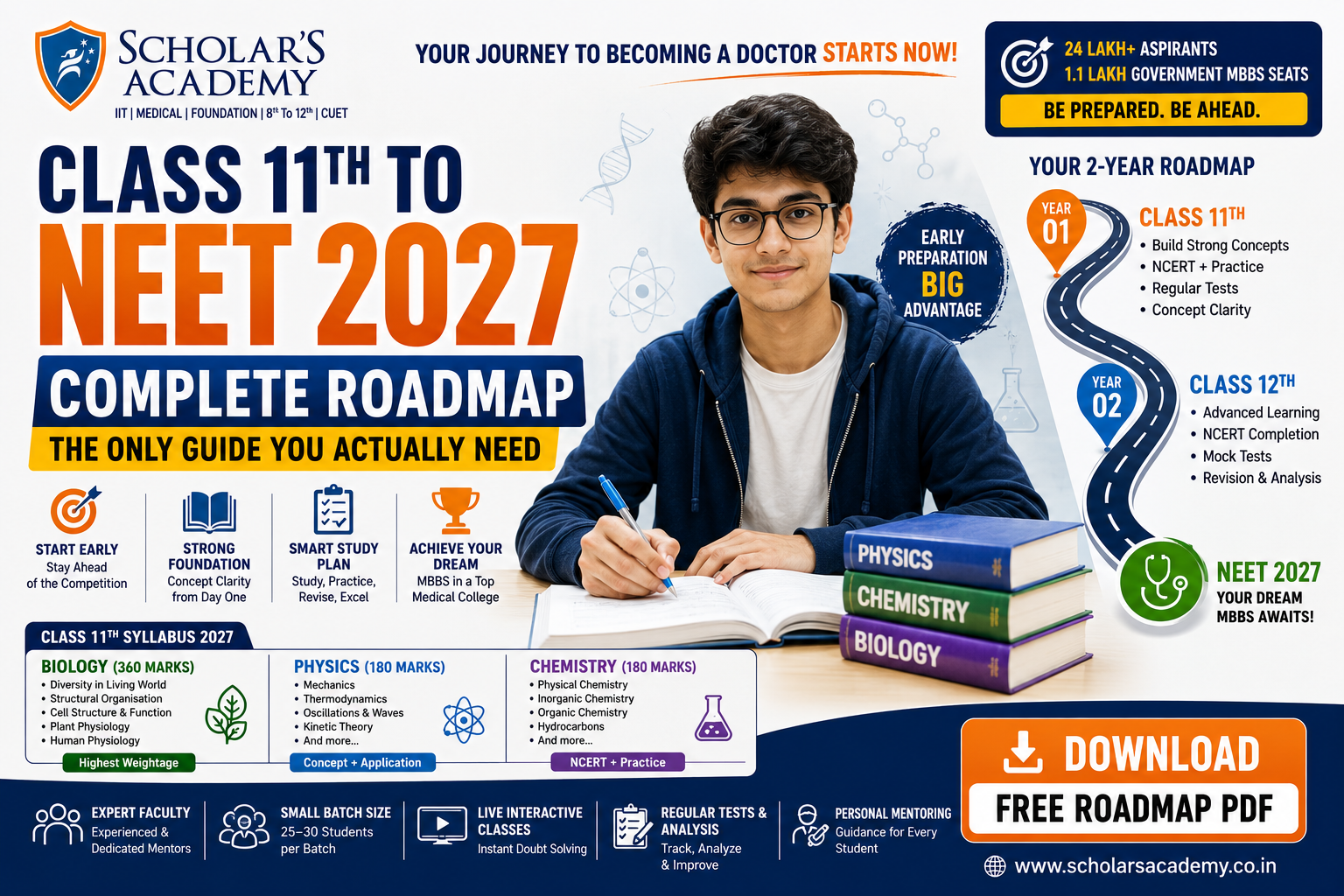
Most students who crack NEET on their first attempt share one thing in common: they didn’t start preparing in Class 12. They started in Class 11, quietly and without much fanfare, and by the time everyone else was scrambling to cover two years of syllabus in ten months, they were already revising.
NEET 2027 preparation from Class 11 is not just a smart strategy. At a certain level of competition — 24 lakh+ candidates, roughly 1.1 lakh government MBBS seats — it’s the only strategy that gives you a real edge without burning out.
This guide covers the syllabus, the subject-wise approach, how to structure your time, and what kind of support actually moves the needle. —
Why Class 11 Is the Real Foundation Year
Class 11 carries roughly 45–50% of the total NEET weightage. Biology alone has chapters like Cell Biology, Plant Physiology, and Human Physiology that form the backbone of almost every NEET question paper. Physics chapters — Laws of Motion, Thermodynamics, Waves — are the conceptual roots from which Class 12 topics grow. Chemistry’s Physical Chemistry base lives almost entirely in Class 11.
Students who treat Class 11 casually spend their entire Class 12 in recovery mode — relearning concepts they should have understood the first time, under far more pressure. Students who take Class 11 seriously spend Class 12 building on what they know, not rebuilding it.
There’s no mystery to why two years beats one. The NEET 2027 syllabus hasn’t been condensed. The exam still tests depth, not just coverage. —
The NEET Class 11th Syllabus 2027: Subject-Wise Breakdown
Before building any study plan, you need to know exactly what you’re working with. Here’s what each subject covers in Class 11, and where the actual marks tend to come from.
NEET Class 11th Syllabus 2027 for Biology
Biology contributes 360 out of 720 marks in NEET — the single highest-weightage subject. The Class 11 portion covers 5 major units and roughly 22 chapters. Nearly all questions are sourced directly from NCERT text, diagrams, and examples.
Biology is where NEET is won or lost, and the NEET Class 11th syllabus 2027 for Biology is substantial. The major units are: The Diversity of Living Organisms covers the classification of plants and animals — this unit is often underestimated, but taxonomy questions appear every year.
Structural Organisation in Plants and Animals takes you through the anatomy and physiology of both. Cell Structure and Function is where most students spend the most time in Class 11, and for good reason: Cell Biology questions are consistent NEET scorers.
| Unit No. | Unit Name | Key Chapters / Topics | NEET Weightage |
| Unit 1 | Diversity in the Living World | The Living World; Biological Classification; Plant Kingdom; Animal Kingdom | Moderate — 4–6 questions/year |
| Unit 2 | Structural Organisation in Plants and Animals | Morphology of Flowering Plants; Anatomy of Flowering Plants; Structural Organisation in Animals (Frog) | Moderate — 3–5 questions/year |
| Unit 3 | Cell: Structure and Function | Cell — The Unit of Life; Biomolecules; Cell Cycle and Cell Division | High — 8–10 questions/year |
| Unit 4 | Plant Physiology | Transport in Plants; Mineral Nutrition; Photosynthesis in Higher Plants; Respiration in Plants; Plant Growth and Development | Very High — 10–12 questions/year |
| Unit 5 | Human Physiology | Digestion and Absorption; Breathing and Exchange of Gases; Body Fluids and Circulation; Excretory Products and Their Elimination; Locomotion and Movement; Neural Control and Coordination; Chemical Coordination and Integration | Very High — 12–15 questions/year |
Key notes:
- Plant Physiology and Human Physiology together are the two highest-scoring units in the entire NEET Biology paper.
- Cell Biology (Unit 3) is consistently present in every NEET paper — Cell Cycle and Biomolecules especially.
- Animal Kingdom (Unit 1) and Structural Organisation (Unit 2) are often underestimated; 4–6 questions appear from these units each year.
NEET Class 11th Syllabus 2027 for Physics
Physics contributes 180 marks in NEET. The Class 11 syllabus covers 10 units. Conceptual clarity here is critical — Class 11 Physics forms the mechanical and thermodynamic foundation for almost all Class 12 Physics chapters.
The NEET Class 11th syllabus 2027 for Physics covers Physical World and Measurement, Kinematics, Laws of Motion, Work, Energy and Power, Motion of System of Particles and Rigid Body, Gravitation, Properties of Bulk Matter, Thermodynamics, Behaviour of Perfect Gas and Kinetic Theory, and Oscillations and Waves.
| Unit No. | Unit Name | Key Chapters / Topics | NEET Weightage |
| Unit 1 | Physical World and Measurement | Physical World; Units and Measurements | Low — 1–2 questions/year |
| Unit 2 | Kinematics | Motion in a Straight Line; Motion in a Plane | Moderate — 2–3 questions/year |
| Unit 3 | Laws of Motion | Newton’s Laws of Motion; Friction; Circular Motion | Moderate-High — 3–4 questions/year |
| Unit 4 | Work, Energy and Power | Work-Energy Theorem; Potential and Kinetic Energy; Power; Collisions | Moderate — 2–3 questions/year |
| Unit 5 | Motion of System of Particles and Rigid Body | Centre of Mass; Angular Momentum; Torque; Moment of Inertia; Rolling Motion | Moderate — 2–3 questions/year |
| Unit 6 | Gravitation | Kepler’s Laws; Universal Law of Gravitation; Escape Velocity; Satellites; Orbital Motion | Moderate — 2–3 questions/year |
| Unit 7 | Properties of Bulk Matter | Mechanical Properties of Solids; Mechanical Properties of Fluids; Thermal Properties of Matter | Moderate — 2–3 questions/year |
| Unit 8 | Thermodynamics | Thermal Equilibrium; Laws of Thermodynamics; Isothermal and Adiabatic Processes; Heat Engines; Refrigerators | High — 3–4 questions/year |
| Unit 9 | Behaviour of Perfect Gas and Kinetic Theory | Kinetic Theory of Gases; Mean Free Path; Degrees of Freedom; Specific Heat Capacities | Moderate — 2–3 questions/year |
| Unit 10 | Oscillations and Waves | Periodic Motion; Simple Harmonic Motion; Damped and Forced Oscillations; Wave Motion; Speed of Sound; Doppler Effect | Moderate-High — 3–4 questions/year |
Key notes:
- Laws of Motion and Thermodynamics are the two highest-priority Class 11 Physics units for NEET.
- Kinematics must be mastered first — it underpins every mechanics unit that follows.
- Oscillations and Waves have seen increased weightage in recent NEET papers; don’t treat them as low-priority.
- Units and Measurements (Unit 1) typically yields only 1 question but is useful for dimensional analysis across all numericals.
NEET Class 11th 2027 Syllabus for Chemistry
Chemistry contributes 180 marks in NEET. The Class 11 syllabus spans Physical, Inorganic, and Organic Chemistry — each requiring a different approach. Class 11 Chemistry covers 14 chapters across 14 units.
The NEET Class 11th 2027 syllabus for Chemistry includes Some Basic Concepts of Chemistry, Structure of Atom, Classification of Elements and Periodicity in Properties, Chemical Bonding and Molecular Structure, States of Matter, Thermodynamics, Equilibrium, Redox Reactions, Hydrogen, s-Block Elements, Some p-Block Elements, Organic Chemistry (basic principles), Hydrocarbons, and Environmental Chemistry.
| Unit No. | Unit Name | Type | Key Topics | NEET Weightage |
| Unit 1 | Some Basic Concepts of Chemistry | Physical | Mole Concept; Stoichiometry; Laws of Chemical Combination; Concentration Terms | High — 3–4 questions/year |
| Unit 2 | Structure of Atom | Physical | Bohr’s Model; Quantum Numbers; Orbitals; Electronic Configuration; Heisenberg’s Uncertainty Principle | Moderate-High — 2–3 questions/year |
| Unit 3 | Classification of Elements and Periodicity in Properties | Inorganic | Modern Periodic Table; Periodic Trends — Atomic Radius, Ionisation Energy, Electronegativity, Electron Gain Enthalpy | Moderate — 2–3 questions/year |
| Unit 4 | Chemical Bonding and Molecular Structure | Physical/Inorganic | VSEPR Theory; Hybridisation; Ionic and Covalent Bonding; Hydrogen Bonding; Dipole Moment; MO Theory | High — 3–4 questions/year |
| Unit 5 | States of Matter: Gases and Liquids | Physical | Gas Laws; Ideal Gas Equation; Kinetic Molecular Theory; Liquefaction; Vapour Pressure | Moderate — 2 questions/year |
| Unit 6 | Thermodynamics | Physical | System and Surroundings; Enthalpy; Hess’s Law; Entropy; Gibbs Free Energy; Spontaneity | High — 3–4 questions/year |
| Unit 7 | Equilibrium | Physical | Law of Chemical Equilibrium; Le Chatelier’s Principle; Ionic Equilibrium; pH; Buffer Solutions; Solubility Product | Very High — 4–5 questions/year |
| Unit 8 | Redox Reactions | Physical/Inorganic | Oxidation and Reduction; Oxidation Number; Balancing Redox Reactions | Low-Moderate — 1–2 questions/year |
| Unit 9 | Hydrogen | Inorganic | Position of Hydrogen; Hydrides; Water; Hydrogen Peroxide; Heavy Water | Low — 1 question/year |
| Unit 10 | s-Block Elements | Inorganic | Group 1 and Group 2 Elements; Alkali and Alkaline Earth Metals; Important Compounds (NaOH, Na₂CO₃, CaO, CaCO₃) | Moderate — 2–3 questions/year |
| Unit 11 | Some p-Block Elements | Inorganic | Group 13 and Group 14 Elements; Boron, Aluminium, Carbon, Silicon and their Compounds | Moderate — 2–3 questions/year |
| Unit 12 | Organic Chemistry: Basic Principles and Techniques | Organic | IUPAC Nomenclature; Inductive Effect; Resonance; Hyperconjugation; Reaction Intermediates; GOC | Very High — 4–5 questions/year |
| Unit 13 | Hydrocarbons | Organic | Alkanes; Alkenes; Alkynes; Aromatic Hydrocarbons; Reactions — Addition, Substitution, Elimination | High — 3–4 questions/year |
| Unit 14 | Environmental Chemistry | Organic/General | Atmospheric Pollution; Water Pollution; Soil Pollution; Greenhouse Effect; Ozone Depletion | Low — 1 question/year |
Key notes:
- Equilibrium (Unit 7) and General Organic Chemistry (Unit 12) are the two most important Class 11 Chemistry units for NEET — together they typically account for 8–10 questions.
- Chemical Bonding (Unit 4) is present every year without exception; hybridisation and VSEPR are reliable high-scorers.
- Thermodynamics (Unit 6) requires both conceptual understanding and numerical practice — do not rely on memorisation alone.
- Mole Concept (Unit 1) underpins nearly every numerical in Physical Chemistry across both classes; master it early.
- Environmental Chemistry (Unit 14) is low-effort, high-return — 1 dedicated revision session usually secures the mark.
Quick Reference: Class 11 vs Class 12 Contribution to NEET 2027
| Subject | Class 11 Share (approx.) | Class 12 Share (approx.) | Total Marks |
| Biology | 45 marks (Botany + Zoology) | 45 marks | 360 marks (90 questions × 4) |
| Physics | 40–45 marks | 45–50 marks | 180 marks (45 questions × 4) |
| Chemistry | 35–40 marks | 50–55 marks | 180 marks (45 questions × 4) |
| Total | ~120–130 marks | ~130–140 marks | 720 marks |
How to Actually Structure Your Time in Class 11
The most common mistake Class 11 NEET aspirants make is planning a schedule that doesn’t account for school. You still have exams, practicals, and attendance to manage. Any study plan that ignores that reality won’t survive contact with actual school life.
A workable structure for most students: 5–6 hours of focused NEET study on school days, split across two sessions. One session in the morning before school if possible (even 45 minutes is valuable), one session in the evening. Weekends can carry more — 7–8 hours — but only if the weekday foundation is consistent first.
Subject rotation matters. Don’t spend three consecutive days only on Biology and then touch Physics once a week. A daily or two-day rotation across all three subjects keeps concepts fresh and prevents the uneven preparation that trips up students in mock tests.
Start each chapter with NCERT first, regardless of the subject. Then use reference material — HC Verma for Physics, MS Chauhan or VK Jaiswal for Chemistry, structured notes for Biology — to deepen what NCERT introduced. Not the other way around. —
When and How to Add Coaching to the Mix
Self-study has limits, and most students who crack NEET on their first attempt aren’t entirely self-taught. Good coaching gives you structured pacing, access to faculty who can explain concepts you’ve read three times and still don’t understand, and a peer environment that keeps the competition real without being demoralising.
If you’re based in Delhi, a NEET Coaching Institute in Delhi with experienced faculty across Physics, Chemistry, and Biology — ideally one that integrates Class 11 board preparation with NEET pacing rather than treating them as separate tracks — is worth researching seriously. The right institute doesn’t just give you study material; it saves you from the time lost in identifying which topics to prioritise, which mistakes are common, and where your specific gaps are.
What to look for: faculty with verifiable NEET teaching experience, a test series that mirrors actual NEET difficulty progression, and batch sizes small enough that you can actually ask questions in class.
What to avoid: institutes that promise “guaranteed rank” numbers, or that rush through Class 11 content to get to Class 12 faster. The Class 11 foundation is the preparation. Rushing it defeats the purpose. —
The Role of Mock Tests and Revision Cycles
Most students delay mock tests because they feel unready. This is the wrong instinct. Mock tests don’t just measure preparation — they build it. Attempting a question under timed exam conditions and getting it wrong is one of the fastest ways to remember the correct concept.
In Class 11, aim for at least one chapter-wise test per week, per subject, once you’ve covered enough ground. Full-length mock tests (all three subjects, 200 questions, 3 hours and 20 minutes) are more appropriate from Class 12 onwards, but chapter tests from Class 11 itself build the test-taking habit before the pressure really starts.
Revision cycles are separate from new-learning sessions. Once a chapter is done, it needs a revisit every 3–4 weeks or retention drops sharply. Biology especially: a chapter you studied in July will feel unfamiliar by October if you haven’t touched it again. Build revision into your schedule rather than treating it as something you’ll do “when there’s time.” —
NCERT: The Most Underused Tool in NEET Preparation
This point is worth making plainly because students keep looking for alternatives to NCERT that don’t exist at the foundational level.
NEET questions — across Biology, and significantly in Chemistry — are written with NCERT as the primary source. Questions about the exact wording of a definition, a diagram label, a specific example used in the text: these come directly from NCERT pages. No reference book substitutes for that.
Read NCERT actively: highlight, make margin notes, and test yourself on the end-of-chapter exercises without looking at the answers first. Students who do this seriously — and it takes time — find that a large portion of NEET Biology and Inorganic Chemistry becomes recognisable rather than new on exam day.
You can also cross-reference the Re-NEET 2026 Question Paper PDF with your NCERT chapters to see exactly how questions are framed from source material. That exercise alone tends to change how seriously students take their textbooks. —
Conclusion
NEET 2027 preparation from Class 11 comes down to one decision made consistently over two years: whether you do today’s work today, or push it to next week.
The students who clear NEET on their first attempt at 18 aren’t universally the most talented. They’re the ones who understood early that the syllabus is finite, the exam is learnable, and two years of steady work compounds into something that no amount of Class 12 cramming can replicate.
Class 11 is the year to build that foundation. The marks are waiting in the syllabus. The only question is when you start. —
FAQs on NEET 2027 Preparation from Class 11
Q2. How many hours should a Class 11 student study for NEET per day?
On school days, 5–6 hours of focused study is a realistic and sustainable target. Weekends can extend to 7–8 hours. Consistency over two years matters more than occasional marathon sessions.
Q3. Which subject is most important to focus on in Class 11 for NEET?
All three are important, but Biology's Class 11 units — Plant Physiology, Human Physiology, and Cell Biology — carry the highest NEET weightage, and Physics concepts from Class 11 underpin most of the Class 12 chapters. Don't neglect Chemistry's Physical Chemistry base either.
Q4. Should I join coaching in Class 11 itself or wait for Class 12?
Joining from Class 11 is generally better. Coaching that runs parallel to your board syllabus helps you avoid learning everything twice. Look for a structured NEET coaching programme that integrates board and entrance preparation from the start.
Q5. How do I balance school board exams and NEET preparation in Class 11?
The Class 11 CBSE syllabus and the NEET Class 11th syllabus overlap significantly. Studying NCERT thoroughly for NEET covers most of what you need for boards. The additional effort for boards is mostly in long-answer writing practice — which is separate from, and doesn't conflict with, NEET preparation.