
The Joint Entrance Examination (JEE Main) is considered one of the most challenging entrance exams for Indian students aspiring for admission into premier engineering institutions such as NITs, IIITs, and other top engineering colleges. Annually, millions of students sit for this examination with the aim of achieving a distinguished rank.
JEE Main 2026 preparation demands immense perseverance, clear comprehension of concepts, and regular practice in Physics, Chemistry, and Mathematics. Numerous students start their preparation a few months or even years ahead of the exam. But as the exam nears, the revision of the entire syllabus in a limited period remains a significant concern for students.
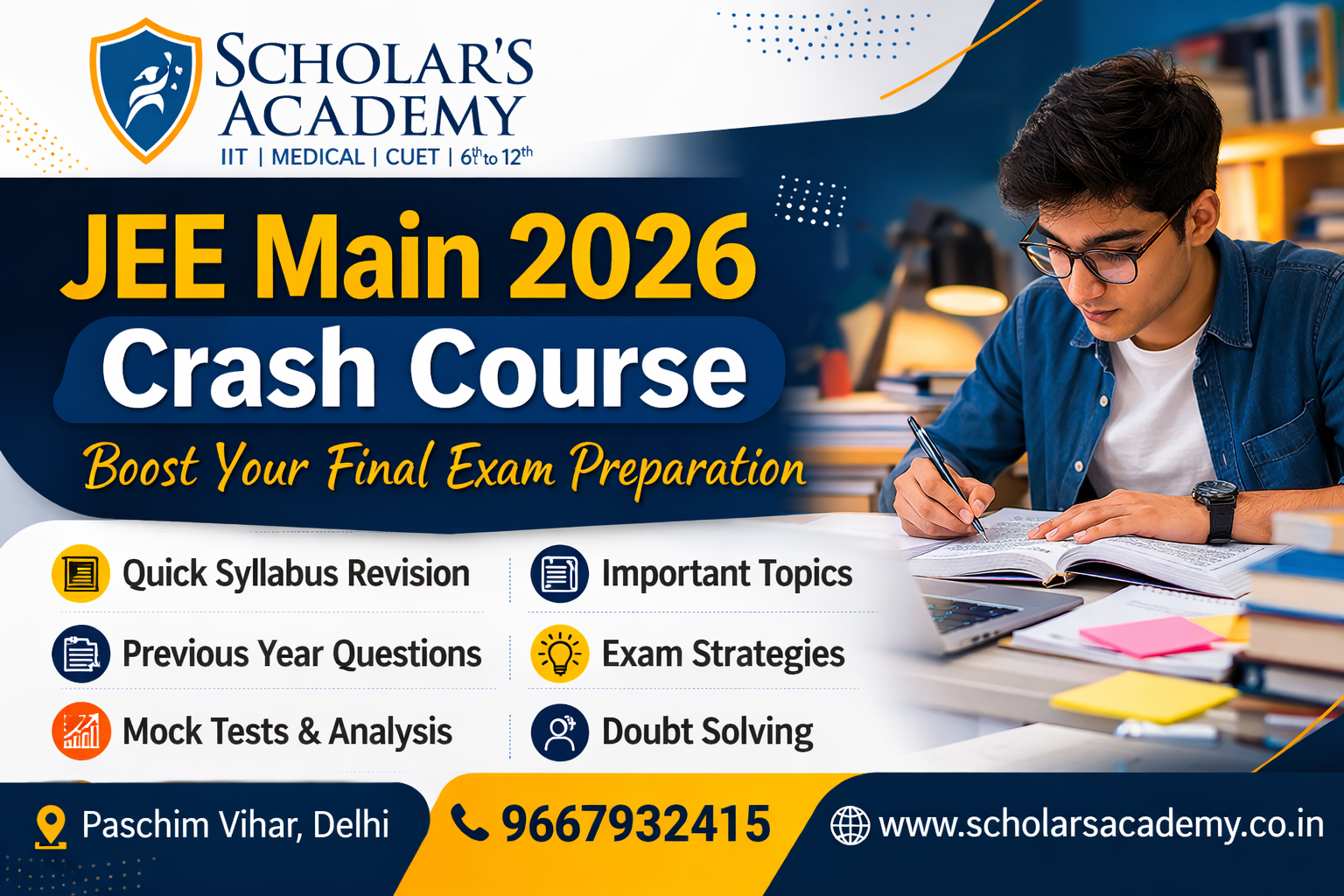
Therefore, a JEE Main Crash Course is a great aid in this situation. Such a course aims at delivering brisk revision, focused practice sessions, and expert guidance to students in their last few days of preparation. Concentrating on top scoring areas, solving past years’ question papers, and mock tests being some of the steps through which a crash course helps students not only consolidate their readiness but also excel in the examination.
We are going to discuss how enrolling in a JEE Main 2026 Crash Course can aid students in upgrading their preparation and why it has turned into a vital component of the ultimate preparation plan for a good number of aspirants.
Why Students Join a JEE Main Crash Course
In pursuit of JEE Main, most students engage in self-study, attend school classes, and coaching sessions over several months. Yet, as the examination date inches closer, many students experience anxiety mainly because they have not revised all the topics thoroughly.
JEE Main crash course can be instrumental in helping students get their act together and revise the syllabus comprehensively yet efficiently.
Following are a few reasons why students prefer to join a crash course at the tail end of their preparation:
- Quick and Structured Revision
Fast syllabus revision is probably the biggest advantage of a crash course. Rather than studying in a haphazard manner, students adhere to a well-laid-out plan that carves out the essential chapters of each subject for special treatment.
Teachers assist students by clarifying the most crucial concepts, formulas, and methods that would be required in the examination.
- Focus on Important Topics
JEE Main has a comprehensive syllabus but only a few units weigh much in the actual exam. Crash courses guide students to pay their attention to the topics that yield the maximum marks and also tend to appear frequently in JEE Main.
By this way, students are made aware of the areas where they should focus their time and efforts for the best results in the exam.
- Better Problem-Solving Practice
JEE Main demands not only conceptual clarity but the students must be skilled enough to formulate solutions within a given time frame without compromising on accuracy. The crash courses consist of heavy problem-solving exercises during which students get to solve the questions under the supervision and guidance of the teacher.
Performance aspects such as speed, accuracy, and confidence, are thereby enhanced.
- Exam Strategy and Time Management
Getting to know how to divide your time between different sections and questions during the exam is a crucial factor. Crash courses also focus on this skill by equipping students with techniques not only to select the right questions but also to avoid mistakes and complete the paper in the allotted time.
Importance of Revising High-Weightage Topics
The JEE Main exam pattern is such that a handful of topics are tested quite regularly year after year. Those JEE aspirants who mainly concentrate on these chapters with heavy weightage end up scoring significantly better marks.
That’s why crash courses are created to spot and revise these crucial areas in a quick, effective way.
As a matter of fact, some of the most frequently tested areas are as follows:
Important Physics Topics
Physics questions in JEE Main are usually conceptual and numerical. Some of the most important topics include:
- Electrostatics
- Current Electricity
- Modern Physics
- Ray Optics and Wave Optics
- Thermodynamics
- Oscillations and Waves
These chapters often contain questions that can be solved quickly if students understand the concepts clearly.
Important Chemistry Topics
Chemistry is considered one of the highest scoring subjects in JEE Main if students revise important concepts thoroughly.
Some important topics include:
- Chemical Bonding
- Coordination Compounds
- Organic Reaction Mechanisms
- Thermodynamics
- Electrochemistry
- Biomolecules and Polymers
Regular revision of these chapters helps students improve both speed and accuracy.
Important Mathematics Topics
Mathematics requires strong conceptual understanding and consistent practice.
Some frequently asked topics include:
- Calculus
- Probability
- Matrices and Determinants
- Sequence and Series
- Vector Algebra
- 3D Geometry
Practicing problems from these topics can significantly improve students’ performance in Mathematics.
Role of Previous Year Questions in JEE Preparation
Practicing previous year questions (PYQs) is considered as one of the most powerful tools to get ready for JEE Main.
Last year’s papers not only help students with knowledge of the actual exam procedure, level of difficulty but also understating the important concepts being asked. By attempting these questions, they gain confidence in their understanding of what may be asked during the day of the exam.
In the course of the crash program, instructors examine years back papers and reveal different techniques on how to answer these questions quickly.
Attempting PYQs is advantageous for students as it helps them to:
- Gain familiarity with the format of JEE Main questions
- Have a look at the frequently asked concepts
- Work on their problem-solving skills
- Feel more confident on the exam day
Regularly going through previous year question papers ensures that the student gets accustomed with the type of problems asked in the exam and hence eligible to perform better on the day.
Mock Tests and Performance Analysis
Mock tests should be included as highly effective tool for anyone preparing for JEE Main. They not only give a feel of the real exam environment but also show how prepared one is for the exam.
Most of the crash courses include tests based on individual chapters as well as full syllabus mock tests.
Tests like these are very beneficial for students in the following areas:
- Accustomed to minute details of the questions asked
- Improving speed and accuracy
- Finding out areas of weaknesses
- Creation of a good exam plan
After every test, students are given feedback in the form of explanations, which is very helpful in guiding them to learn from their errors and change their performance.
Benefits of Joining a JEE Main Crash Course
An efficiently structured crash course is a very effective tool that can provide students with lots of benefits and enhancement in their preparation.
- Quick and focused revision
With the help of a crash course, students get an opportunity to cover the whole syllabus in a very short period of time while at the same time focusing on the key concepts.
- Mentoring by Specialists
Faculty members with lots of experience give students the right study plans and sharing of the tips for the exam.
- Doubt Clearing Sessions
Query solving sessions are often a part of crash courses, and through these, students get an opportunity to clear the difficult topics.
- Confidence Level Raised
Students who regularly practice, test, and revise will find their confidence building up gradually leading to the day of the exam.
Finding the Best JEE Coaching Near You
A lot of students type “JEE coaching near me” when trying to find a little extra help with their JEE prep.
Since your choice of a coaching institute is bound to make a major difference in your preparation quality, it’s only natural that you’ll want to pick the best one.
Here are some parameters you can look into while making your decision:
- Highly qualified and skilled teachers
- Well-planned curriculum and study schedule
- Regular testing and performance evaluation
- Interactive doubt clearing sessions
- Easy accessibility and a motivating study atmosphere
Besides academic guidance, a reliable coaching institute will help you with motivation so that you don’t lose sight of your goals.
JEE Coaching in Paschim Vihar, Delhi
Students living in Paschim Vihar and nearby areas of West Delhi frequently search for JEE coaching institutes that offer comprehensive JEE Main preparation programs.
Teaching centers here provide physical classroom sessions, hands-on practice, and revision workshops, which aid students in their preparation efforts.
Some students prefer JEE Main last-hour crash courses since they provide a quick review and focused practice during the final phase of preparation.
Final Preparation Strategy for JEE Main 2026
Rather than attempting to cover new concepts at the last minute, students should focus on their efficiency in preparation during exam weeks.
Following are some of the fundamentals of an effective prep strategy:
- Keeping the significant formulas and concepts fresh through regular revision
- Going through the questions of previous years
- Mock test sessions for gaining speed and precision
- Keeping away from unnecessary worries and following a balanced lifestyle
- Maintaining a consistent study regimen
With a good plan and the right mentorship, candidates will perform at their best in the examination.
Conclusion
The final moments of preparation are extremely important for a student’s success in JEE Main 2026. An organized JEE Main Crash Course gives students the opportunity to recall the important portions, practice the questions of past years, and work on their exam strategy.
By applying stringent focus on chapters which carry a higher weightage, taking mock tests, and having a clear grasp of the concepts, students can level up their preparation and walk into the exam with confidence.
Constant practice, intelligent revision, and professional guidance can bring about a huge change in a student’s JEE Main score and rank.