

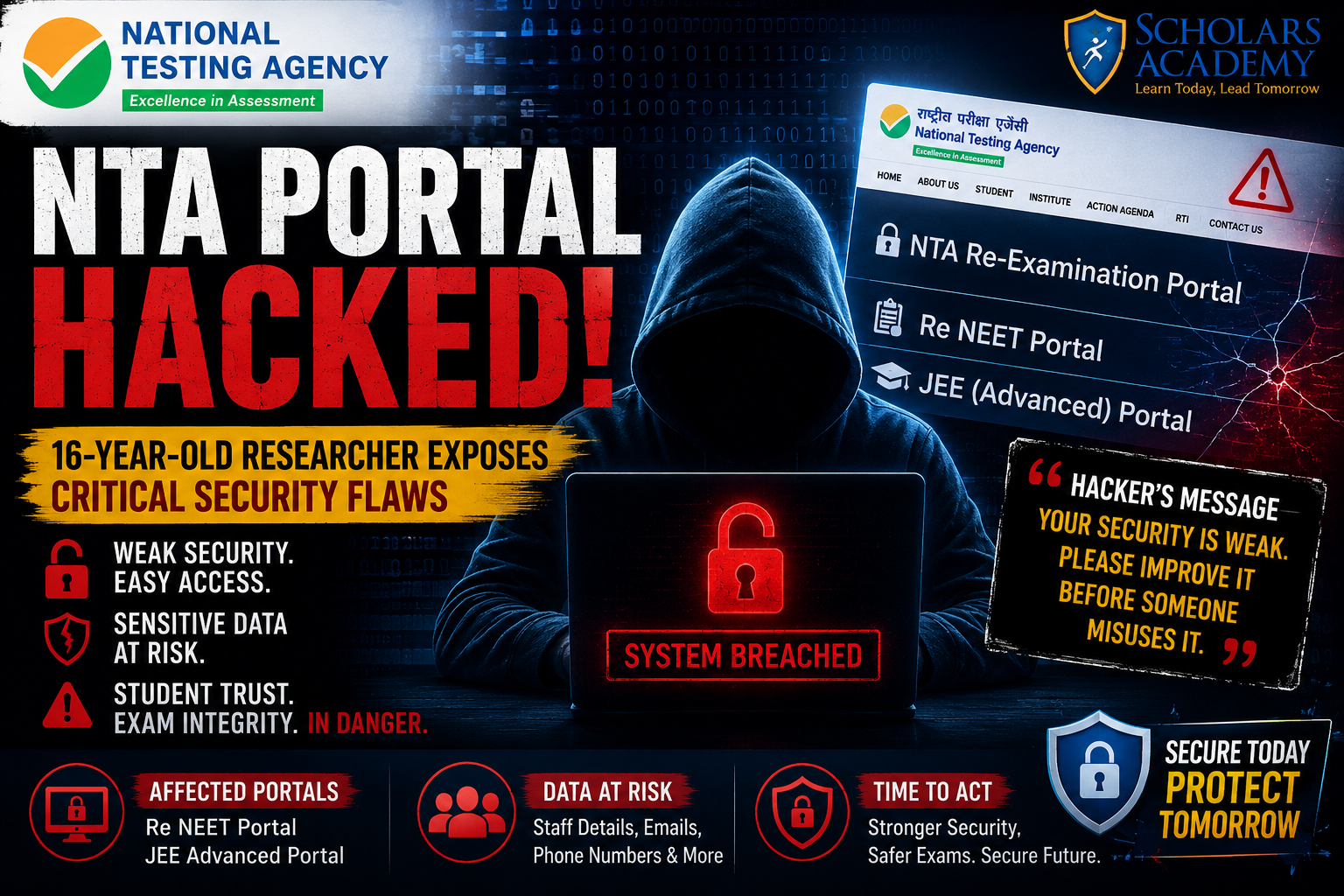
Just as millions of students were bracing themselves for the RE-NEET 2026 re-examination, a bombshell dropped on Indian social media. A 16-year-old cybersecurity researcher named Rylen Anil publicly exposed critical vulnerabilities in the NTA website and its re-examination portal — and the internet erupted. In an era where national-level examinations determine the futures of crores of students, the revelation that the NTA portal hacked — or at the very least, left dangerously wide open — has raised urgent and uncomfortable questions about the digital infrastructure protecting India’s most important tests.
Millions of students were about to take the RE-NEET 2026 re-exam when shocking news spread out on Indian social media. Rylen Anil, a 16-year-old cybersecurity researcher, disclosed the biggest security flaws of the NTA website and its re-exam portal – and the internet went crazy! National-level exams are the gateway for the future of millions of students and this news that the NTA portal hacked – or at least left open for attack – is forcing us to raise serious questions about the digital infrastructure that protects India’s most important exams.
What Exactly Happened? The NTA Portal Hacked Incident Explained
Rylen Anil posted on X(formerly Twitter) a thread exposing the security flaws of the NTA’s re-exam portal on May 31, 2026. In his thread, he exposed that the NTA portal security was so weak that it was almost as if the door was wide open.
He wrote that the portal was left with a “superadmin login bypass” which could be abused with such weak credentials that the hacker does not even have to put much effort in this. In other words, it was very much like the security was so vulnerable that someone who just really knows the basics of IT could get through the “front door” of the NTA portal’s administrative backend without any special hacking tools. It wasn’t a deeply hidden bug that he found, but rather an unlocked window located on the ground floor.
Even from there, the vault was just thrown wide open. The bypass, in fact, led directly to the superadmin panel of the website, whereby the site offered the main admin functions such as exam observer management, exporting CSV, creation and downloading of appointment letters, template uploading, and nodal officer mappings. So basically, a stranger could, without much difficulty, have tampered with the fundamental examination system.
What Data Was Exposed?
It’s quite unsettling just how much data could have been leaked.
According to Anil, a single blast of the vulnerability could have permitted someone to view the details of roughly 7,900 observers, 676 centre coordinators, and 5,400 exam centres and centre superintendents’ – with their names, email addresses, and phone numbers – among others. One cannot even call this “metadata” because these are real people, and the portal that managed one of the biggest re-exams in India, exposed their Personally Identifiable Information (PII).
The “hacker” message conveyed by him to the NTA was not a malicious one – rather a warning. Anil’s message was that the security posture of NTA is weak and they should take immediate measures to fix it. This is reflective of the ethical hacker community’s tradition of responsible disclosure. Instead of abusing the vulnerabilities for his own benefit, he chose to simultaneously inform the authorities and the public.
The NTA’s Response — And the Suspicious 404 Error
It was very soon after the post of Anil started getting more attention that several people mentioned that the portal link started displaying a “404 Not Found” error message, which led to more questions about the status of the platform. The time was very telling. We do not know whether the portal was taken down for emergency patching or the link just broke under scrutiny. The NTA has not yet commented publicly on the issue and the allegations are still unconfirmed and the matter is waiting for an official verification.
This silence is a message itself. At an organization that manages exams like NEET, JEE, CUET, and many other national-level tests, it is not only a duty but a responsibility to millions of students and their families to provide a prompt and transparent response to cybersecurity allegations.
Why This Matters: The Bigger Picture of NTA’s Troubled Year
This event is not a stand-alone one. The very first NEET-UG 2026 test, conducted on May 3, 2026, was surrounded by the incident of mass paper leakage, inflaming the public and legal forums who finally pushed the authorities to cancel the test. In the end, about 2.28 million candidates had to take the test again, with the fresh date set for June 21, 2026.
The NTA website hacked — or “exposed” — the exact time when students were getting ready for their re-examination is a new crisis layer that the repercussions of the incident go beyond mere technical embarrassment. These fresh allegations come at a very difficult moment for the NTA, the body that is already under public and political scrutiny for its inadequate handling of the issuance of the high-stakes national examinations. The Supreme Court has also stepped in and voices its very serious concern over the repeated failures of the agency.
For students, who are still under stress due to the leak of the NEET paper, it is very disturbing that the NTA portal hacked by a teenager — using “extremely weak credentials” — keeps on breaking out in the news. If a 16-year old child can easily get past the superadmin login of a platform that holds the records of czars of students, then what kind of security has been left here?
What This Means for Students Appearing in High-Stakes Exams
Candidates studying for NEET, JEE Advanced, and CUET should consider that their private data — including phone numbers, email addresses, and examination records — could have been compromised. Although no cases of deliberate data misuse have been communicated yet, the mere knowledge of such data getting into the hands of potential ill-intentioned persons is certainly a matter of grave concern with respect to privacy.
Extending from just personal information, the very concept of fair play and transparency in education is also threatened. Should the admin panel of the portal be accessed by a non-authorized individual, it is quite a stunning thought that even if the manipulation of coding of attendants, centres mapping, or iterations of letters was done, the authorities might not even be aware of it without conducting a thorough investigation.
Parents and educators who support programs such as IIT JEE Online Coaching and other intensive preparations that come along with high stakes examinations deserve to know that the digital environment where these examinations rule is made equally rigorous as the examinations themselves.
The Demand for Urgent Cybersecurity Reform
The Indian educational examination organizations must take cybersecurity very seriously and no longer delay treating it as something of an afterthought. The usual intention is to plan for making a whole time portal free from attacks only after its successful launch, whereas really it is high time that the authorities should realize the importance of rolling it out continuously along with its monitoring.
A minimum of measures is that the NTA needs to get cybersecurity auditing conducted by independent third parties, make multi-factor authentication the only route to gaining access for admin operations, carry out the mandatory penetration testing prior to making the portal public, finally, a bug bounty program on the lines of formal ones should be set up so as to encourage ethical hackers like Rylen Anil to report vulnerabilities through official channels as opposed to social media.
Conclusion: Preparation Must Go On — But So Must Accountability
For students, the message is clear: do not let this controversy derail your preparation. Exams will be conducted, results will be declared, and your hard work will matter. Whether you are preparing for NEET, JEE, or CUET, the focus must remain on your academics. For those seeking structured, expert-led preparation, CUET Coaching in Paschim Vihar and similar established centres continue to offer rigorous guidance and consistent academic support to help students stay on track regardless of the chaos surrounding examination bodies.
For the NTA and the government, however, there is no room for complacency. The NTA portal hacked — or exposed — by a teenager is not a minor embarrassment. It is a systemic warning. India’s examination ecosystem carries the weight of millions of dreams. It deserves protection worthy of that responsibility.