

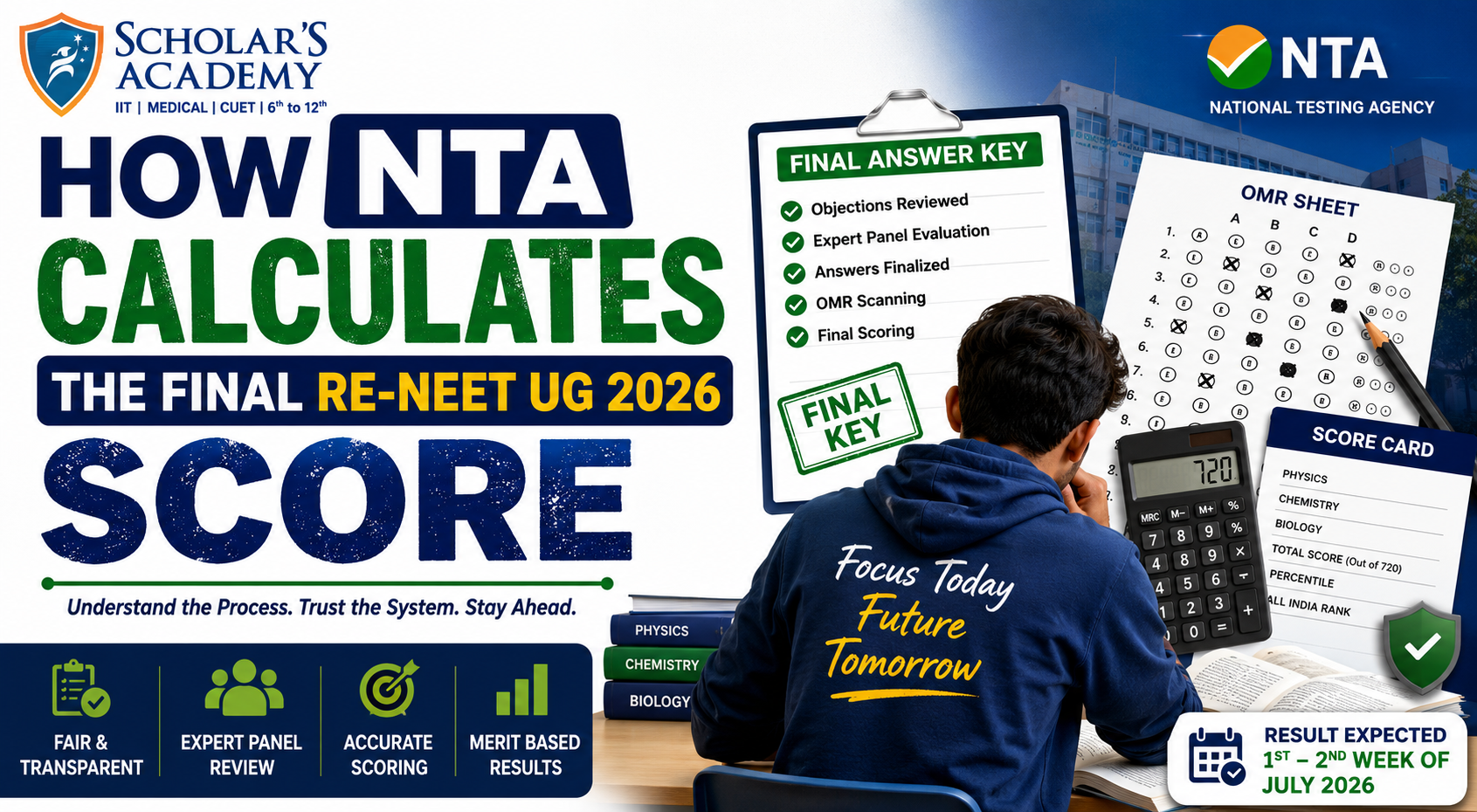
Currently, lakhs of Re-NEET UG 2026 candidates are doing the same thing: referring to their OMR sheets, opening the provisional answer key PDF, and tallying their marks question by question. That is a good thing to do. However, it is not a final verdict. The figure you calculate tonight is only a guess. NTA Calculates the Final Re-NEET UG 2026 Score uses a definite, multi-stage approach – one that has been put in place to allow for keys to be challenged, questions to be revised, and in some cases questions to be completely removed.

You will greatly benefit from understanding that process now, as it will spare you from a lot of unnecessary worry during the next two weeks.
X The Official Process Followed by NTA
Scoring does not happen instantly once candidates step out of the examination hall. Apart from answers, there is a certain order of things, and one step cannot be started until the previous one has been completed. The greeting/provisional answer key is the beginning. NTA published this provisional key for Re-NEET UG 2026 (June 21 exam resulting from the May 3 paper cancellation due to the leak investigation) on June 25 at 7:26 PM, covering all four paper codes: 50, 60, 70, and 80.
Then candidates get a period to raise a challenge against an answer which is considered to be wrong. For this cycle, the challenge period was from June 25 to June 28, with a ₹200 fee for each question challenged. Each contention is then sent to a group of subject-matter experts who consider the challenge in light of recent syllabus and source materials. NTA will only release the final answer key after the completion of the above review. It is only then that the agency will score every OMR sheet by matching it with the final key. Besides, NTA has implemented a new method this year: OMR scanning is being done in parallel with the review of objections, as a result of which the release of the results is expected to be quicker as compared to the previous ones.
The Official NEET Marking Scheme
The marking scheme that is used is unchanged. It’s also a good idea to highlight it here once again because there is a lot of confusion due to candidates miscounting their marks. A correct answer is rewarded +4 marks. An incorrect answer is penalized by -1 mark. An unattempted question fetches zero – no penalty, no reward.
There are a total of 180 questions in the paper comprising of the three subjects – Physics, Chemistry, and Biology. At the most, a candidate can get 720 marks. This is a very simple formula but if you do it under time pressure you can easily end up making an error. Aakash’s evaluation of this cycle has revealed a fact that candidates most times do not realise: an error of just 8 to 12 marks – 2 to 3 questions wrongly counted – can cause a jump or fall of one thousand ranks in the range 500 to 650, where the majority of students are placed.
This is a densely populated score range, so even small errors will lead to large differences in rank.
How Exactly Does the Final Answer Key Affect Your Score
This is the area where a lot of confusion stems from. Your self-estimated score, which is based on the provisional key, is actually different from the score that gets printed on your scorecard. NTA doesn’t just scan your OMR answer sheet one time and call it a day; it scans your sheet solely based on the final answer key – the one released after all the objections have been reviewed and the answers have been amended. If during the review process, your objection to a question is found correct, that particular answer gets changed or if the question is faulty, it is removed from scoring. Standard NTA’s first response in such cases, when a question is removed, is full marks to all the candidates who even attempted it, no matter which answer option they chose. This solitary rule is powerful enough to alter hundreds of thousands of individual scores by a few marks here and there, and this is why you see the ranks corresponding to marks data between the provisional stage and the final result vary so much. Therefore, if you find your provisional-key score and your final scorecard differ significantly, do not assume an error on your part. That is simply the system doing its job.
How NTA Calculates Your Final Marks
After agreeing upon the final answer key, the actual calculations are straightforward. NTA Calculates Your Final Marks by comparing each student’s recorded OMR responses to the final key, granting +4/-1 marks question-wise, and determining a raw score out of 720. Afterwards, that raw score is used for calculating percentile – the relative performance of a candidate vis-à-vis others who appeared in the same session. Only then the All India Rank and category-wise ranks are assigned. The scorecard that NTA eventually publishes comprises your subject-wise marks for Physics, Chemistry, and Biology, your total score, percentile, and rank – all of these created from the final-key evaluation. Many students mistakenly think that NTA recalculates scores in batches or releases partial results. The reality is that the entire 22.79 lakh candidate pool for Re-NEET UG 2026 is evaluated together, against the same final key, at the same time. That’s also the reason the results usually come as a single declaration rather than in a staggered manner. If you want to find out which questions get changed or marked for potential revision, try to compare the Re-NEET 2026 Question Paper PDF with the official answer key. You will be able to see where the ambiguities in the paper were. This is helpful not only for your own score estimation but also to understand why your marks may shift in the future.
Can Your Expected Score Change?
Yes, absolutely — and this is what many candidates find hard to believe. Your expected score may go either up or down from now until the day the results are announced. For example, if the NTA agrees to a challenge and changes the answer, then everyone who chose the new answer will get marks they hadn’t planned on, but those who had counted on the original “correct” option may lose marks. If the question is removed altogether, then the scores usually increase for everyone, as the dropped questions are mostly awarded to all candidates attempting the paper. Now you see why constantly trying to figure out your score every time a new discussion about an answer comes up online doesn’t actually help you get closer to certainty. The figure that truly matters is the one drawn from the final answer key, once the expert panel has completed the review — not the one circulating around the coaching forums in the meantime.
Where and How to Check Your Final Score
The only place where you can get your official Re-NEET UG 2026 result is the NEET official website at neet.nta.nic.in. The scorecards provided by other websites, including coaching institute score calculators, are not official. After the result is out, the steps are quite simple. Go to the official website, search for the “Re-NEET UG 2026 Result” link under Candidate Activity or News & Events, and then login with your application number along with your date of birth or password, plus the security PIN shown on screen. Then your scorecard will display your final score, percentile, and rank — which are all based on the final answer key evaluation as mentioned above. Considering the timeline NTA has given for this cycle, the result is likely to be released somewhere between the first and second week of July 2026, with a few estimates pointing toward July 15. However, do treat any date before the official notification as tentative, as is the practice with every stage of this process.
Conclusion
The discrepancy between your self-computed score and your official Re-NEET UG 2026 result is not a defect in the system — it is the system functioning the way it should. NTA’s mechanism is designed specifically to identify errors in the provisional key so that they do not get permanently reflected in your scorecard. So if your predicted score is near a cutoff or a rank boundary that is significant for you, do not give in to the temptation to treat it as final. Instead, wait for the official result, get your counselling papers ready in the meantime, and use this time constructively rather than with anxiety. No matter what the final figure is, you will have a better, more precise understanding once NTA completes its review — and that understanding justifies the short wait.
FAQs
Q2. How does NTA calculate your final marks after the objection window closes?
A group of subject experts assesses each and every valid objection that is received during the time interval of the challenges. Subsequently, the NTA publishes the revised final answer key reflecting the changes that have been accepted, and the OMR sheet of each and every candidate is assessed against this final key using the standard marking scheme +4/-1.
Q3. What happens if NTA drops a question from the Re-NEET UG 2026 paper?
In the NEET exams in the past, when a question is officially eliminated due to both options being ambiguous or out of the syllabus, all the candidates who have answered the question get the full mark irrespective of their chosen option. This is one of the top reasons why when the final score is released it is different from the provisional estimate.
Q4. Where can I check my final Re-NEET UG 2026 score?
Nowhere else, only through the official NTA website, neet.nta.nic.in, under the Re-NEET UG 2026 Result section. To get your result, you will also need your application number, date of birth or password, and the security PIN shown on the login screen.
Q5. Should I keep recalculating my score using different unofficial answer keys?
Getting the answers from different sources will result in different answer keys. This is going to generate confusion and the answer key you should refer to is the official final answer key from NTA only. After you have calculated your marks with the official provisional key, filing an objection where it is really warranted, and then waiting for the official result is the only way to go.
